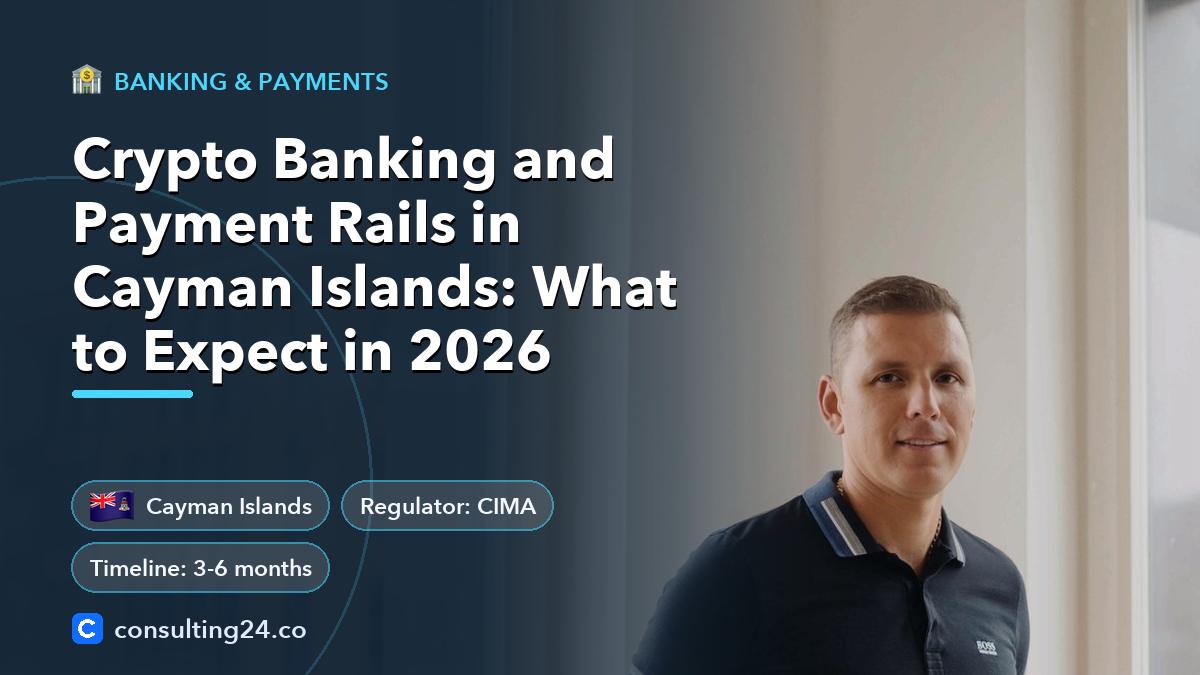
Crypto banking and payment rails in Cayman Islands: what to expect
The Cayman Islands is positioning itself as a hub for crypto banking and payment services, offering a regulated environment for digital asset businesses. Understanding the local framework is essential for firms seeking to integrate crypto payment rails with traditional banking.
Regulatory Environment for Crypto Banking
The Cayman Islands Monetary Authority (CIMA) regulates virtual asset service providers under the Virtual Asset Service Provider Act (VASP Act) and the Proceeds of Crime Act. While there is no specific 'crypto banking' licence, firms offering payment services or custodial wallets must register as a VASP. The regime is designed to align with FATF standards, requiring strong AML/CFT controls.
For crypto banking and payment activities, entities typically need to be licensed under the Banks and Trust Companies Act if they accept deposits or provide lending. However, many firms operate under the VASP Act while partnering with licensed banks for fiat rails. This dual structure allows for crypto payment processing without full banking licence requirements.
Payment Rails and Infrastructure
Cayman Islands payment rails for crypto businesses often rely on correspondent banking relationships and local payment processors. The jurisdiction has a well-developed banking sector with international banks that are increasingly open to working with VASPs, provided they have strong compliance frameworks. Real-time gross settlement (RTGS) systems are available for fiat transactions, but crypto-to-fiat conversion typically occurs through third-party exchanges or OTC desks.
For firms looking to offer crypto payment services, integrating with existing payment gateways or obtaining a money services business licence may be necessary. The Cayman Islands does not have a central bank digital currency (CBDC) yet, but the government is exploring digital payment innovations. Expect to rely on stablecoins or fiat-backed tokens for settlement.
Licensing Options for Crypto Payment Services
The primary licence for crypto banking and payment activities is the VASP registration, which covers exchange, transfer, and custody services. For payment initiation or account issuance, a money services business licence under the Money Services Act may be required. The capital requirement for a VASP is around KYD 100,000 (approx. USD 120,000), but this can vary based on activity type.
Firms offering crypto banking services, such as lending or deposit-taking, need a full banking licence under the Banks and Trust Companies Act. This is more capital intensive, with minimum capital of KYD 4 million (approx. USD 4.8 million) for a Class A bank. Most crypto payment firms opt for the VASP route and partner with licensed banks for fiat services.
Tax Considerations for Crypto Payment Businesses
The Cayman Islands imposes no direct taxes on income, capital gains, or corporate profits. Crypto businesses can operate with 0% corporate tax, though they must pay annual licence fees and registration costs. There is no VAT or GST on crypto transactions, making it attractive for payment rails.
However, firms must be aware of economic substance requirements. A VASP or banking entity must have adequate physical presence, including a local office, staff, and management. Failure to meet substance rules can result in penalties or licence revocation. For crypto payment firms, substance can be outsourced through licensed service providers.
Challenges and Opportunities
One challenge is the limited number of local banks willing to provide fiat accounts for crypto businesses. Many Caymanian banks are conservative, requiring extensive due diligence. This can delay the setup of payment rails. However, the jurisdiction's regulatory clarity and political stability are major advantages for long-term operations.
Opportunities include the ability to serve international clients without withholding taxes, and access to a sophisticated legal and financial ecosystem. The Cayman Islands is also a hub for hedge funds and investment vehicles, which may integrate crypto payment rails for capital calls or redemptions. As the market matures, more banking partnerships are expected.
Steps to Establish Crypto Banking and Payment Services
First, determine the scope of services: payment processing, custody, exchange, or full banking. Then, incorporate a Cayman Islands exempted company or limited liability company. Engage a local law firm to prepare the VASP application or banking licence application, including a business plan, AML policies, and financial projections.
The application process can take 3 to 6 months for a VASP, and longer for a banking licence. During this time, secure a local office and hire a compliance officer. Once licensed, establish correspondent banking relationships and integrate with payment processors. Ongoing compliance includes quarterly reporting to CIMA and annual audits.
How to Choose the Right Jurisdiction
Work the decision in this order: customers first, everything else second:
- Who are your customers? EU retail means you need a MiCA passport (Lithuania, Malta or another EU CASP). US customers mean state-by-state money-transmitter licensing or a FinCEN MSB, so consider a Canada MSB or a US setup. Latin America, Asia or HNW clients mean an offshore or territorial base such as Panama is usually the better fit.
- Do you need a regulator badge? A public-facing exchange chasing institutional partners and fundraising often needs the reputational lift of an EU, Swiss or VARA licence. An OTC desk or token treasury usually does not.
- What is your budget and timeline? Offshore and territorial routes set up in weeks for tens of thousands; premium onshore licences take many months and six figures.
- What about tax? Territorial-tax jurisdictions like Panama charge 0% on foreign-source income; EU jurisdictions apply standard corporate tax. Factor total cost of ownership, not just setup fees.
For many offshore-first founders, Panama lands at the intersection of fast incorporation, low cost and 0% tax on foreign-source income, which is why it features so heavily in our work. But the honest answer is that the “best” jurisdiction is the one that matches the four answers above, and that is a conversation worth having before you spend a cent. See our cost breakdown and application process to ground the decision in real numbers.
Banking and Compliance: Where Most Setups Actually Stall
Incorporation is the easy part of any crypto project. Banking is where timelines slip and where under-prepared founders lose months. Since 2023, banks and payment processors worldwide have tightened their onboarding of crypto-adjacent businesses, and they now expect a genuinely professional application , not a one-page business summary. A thin file is simply rejected, and re-applying with the same bank is far harder than getting it right the first time.
Three documents do the heavy lifting. The first is a written AML/KYC compliance program: your customer-onboarding flow, transaction-monitoring rules, sanctions and PEP screening, a named compliance officer, and record-keeping policies. The second is a clear, evidenced source-of-funds file for both the company and its beneficial owners. The third is a coherent business description that explains who your customers are, how money moves, and what volumes you project. Banks approve businesses they understand; ambiguity reads as risk.
Sequencing matters as much as substance. The correct order is: incorporate the operating entity, build the compliance program, assemble the source-of-funds package, and only then approach banking, ideally through a warm introduction rather than a cold application. Founders who approach banks mid-setup, before their file is complete, create the very delays they are trying to avoid. We make direct introductions to banks and crypto-friendly payment rails as part of every engagement, but the introduction only works if the file behind it is ready.
None of this is optional, and none of it changes much from one jurisdiction to the next, the compliance bar is now broadly global. What changes is the appetite of local banks and the speed of onboarding. Our requirements checklist sets out exactly what you need to assemble before you approach a bank.
Crypto Licensing in 2026: The Bigger Picture
Choosing where to license a crypto business in 2026 is no longer a simple cost calculation. The regulatory map has hardened considerably over the last three years. In the European Union, the Markets in Crypto-Assets Regulation (MiCA) has replaced the patchwork of national VASP registers with a single Crypto-Asset Service Provider (CASP) authorisation that passports across all 27 member states. That passport is powerful, but it comes with capital requirements, governance obligations and a multi-month authorisation process that smaller projects often underestimate.
Outside the EU, the picture is more varied. Offshore and territorial-tax jurisdictions compete on speed, cost and privacy, while major financial centres such as Switzerland, the UAE and Singapore compete on credibility and institutional access. The Financial Action Task Force (FATF) sits over all of them: its “travel rule” and AML standards now apply, in some form, almost everywhere a serious crypto business would consider basing itself. Jurisdictions that ignore FATF expectations end up grey-listed, which quietly closes correspondent-banking doors for every company registered there.
This is why the question behind Crypto banking and payment is rarely “which licence is cheapest?” It is “which regime matches my customers, my risk appetite and my banking needs?” An EU-retail exchange and an offshore OTC desk serving high-net-worth clients in Latin America have almost nothing in common in terms of the right base. Getting this decision right at the start saves you from the single most expensive mistake in the industry: licensing in the wrong place and having to re-domicile a live business.
Consulting24 has guided more than 200 crypto company setups across 15+ jurisdictions since 2017, which means we have seen how each of these regimes behaves in practice rather than just on paper. The summary below is the same framework we use with clients, and we are always happy to map it to your specific model. Start with our Panama vs Lithuania comparison to see how the trade-offs play out between an offshore base and an EU-passported one.
Common Mistakes to Avoid
The failures we see when founders research Crypto banking and payment on their own are remarkably consistent, and almost all of them are avoidable. The first is licensing to the headline tax rate. A 0% jurisdiction is worthless if your customers legally require a regulated provider you cannot become there, and you will simply have to start again. Decide who you are allowed to serve first, then optimise for tax.
The second is treating the compliance program as paperwork. The AML/KYC program is not a formality to satisfy a regulator; it is the document your bank reads most closely. A generic template downloaded from the internet is transparent to any compliance officer and will sink your banking application. It needs to reflect your actual product, customer base and risk profile.
The third is underestimating banking lead time. Founders routinely budget for incorporation and forget that the bank account, the thing that actually lets the business operate, can take longer than the licence itself. Build banking into your launch timeline from day one, not as an afterthought.
The fourth is ignoring personal tax residency. A company in a low-tax jurisdiction does not erase your obligations where you personally live. Many founders create unexpected liabilities by structuring the company perfectly and ignoring themselves. We introduce qualified tax advisors precisely to close this gap.
The fifth and most expensive is choosing a provider on price alone. The cheapest setup that results in a rejected bank application or a re-domiciliation is far more expensive than doing it properly once. Ask any provider to itemise their fee and explain their banking track record before you commit.
What Happens After You Are Licensed
Getting licensed and banked is the start, not the finish. Every regulated or registered crypto business carries ongoing obligations, and letting them lapse is how companies lose their standing, and their banking. At minimum you will maintain a registered agent or local presence, file annual renewals or supervision fees, keep accounting records, and keep your compliance program live with periodic reviews and updated sanctions and PEP screening lists.
Most jurisdictions also expect you to keep your beneficial-ownership information current and to report material changes, new directors, new shareholders, a pivot in business activity, promptly. Transaction monitoring is not a one-time setup either; screening rules need tuning as your volumes and customer mix evolve. Banks may request periodic refreshes of your KYC and source-of-funds documentation, particularly after a year of trading or a significant change in activity.
This is why we offer ongoing maintenance on an annual retainer rather than treating setup as a one-off transaction. The cost of staying compliant is a fraction of the cost of losing a banking relationship and having to rebuild one from scratch. Plan for it in your year-two budget from the outset, and treat your compliance function as a living part of the business rather than a box you ticked at launch.
It is also worth planning ahead for growth. A structure that suits a pre-revenue startup may not suit the same company once it is processing meaningful volume, adding new product lines, or expanding into new markets. Many of the businesses we work with begin in a fast, low-cost offshore base to validate the model, then add a second regulated entity, an EU CASP, for example, once revenue justifies the cost and the market access genuinely matters. Designing the first structure with that possible second step in mind keeps your options open and avoids a disruptive re-domiciliation later. We map this growth path out with clients during the initial planning stage so the early decisions support, rather than constrain, where the business is heading.
Consulting24 has completed 200+ crypto company setups across 15+ jurisdictions. Talk to our team for a fixed-fee proposal and realistic timeline.
Learn more WhatsApp usEmail mardo@consulting24.co · Phone +372 58155779
About Consulting24 & Mardo Soo
Founder & CEO, Consulting24 · LinkedIn
Consulting24 is an eight-year-old advisory firm that has completed 200+ crypto company setups across 15+ jurisdictions since 2017. Founder and CEO Mardo Soo and the team specialise in crypto, VASP and exchange licensing, from Panama and the EU (MiCA) to Dubai, Canada and the offshore world. We don't push a single “best” jurisdiction; we map your business to the regime that actually fits, then handle incorporation, the AML/KYC compliance program, and banking and payment-processor introductions end to end.
Every engagement begins with an honest conversation about your customers, budget and timeline and ends with a fixed-fee proposal, so you know the all-in number before you commit. We also introduce vetted local lawyers and tax advisors wherever your structure requires them.
Operated by X24Consulting OÜ (Estonian Business Register code 16971898), Põrdi tn 3-63, 10156 Tallinn, Estonia · mardo@consulting24.co · +372 58155779
Frequently Asked Questions
What is the primary licence for crypto payment services in the Cayman Islands?
The Virtual Asset Service Provider (VASP) registration under the VASP Act is the main licence for crypto exchange, transfer, and custody services. For payment initiation, a Money Services Business licence may also be required.
Can I operate a crypto bank without a full banking licence?
No, if you accept deposits or provide lending, you need a licence under the Banks and Trust Companies Act. However, many firms offer crypto payment services without deposit-taking by partnering with licensed banks.
What are the capital requirements for a VASP?
The minimum capital for a VASP is approximately KYD 100,000 (around USD 120,000), but this can vary based on the specific activities and risk profile.
Is there corporate tax on crypto payment profits?
No, the Cayman Islands imposes no corporate income tax, capital gains tax, or VAT. Crypto businesses pay only annual licence fees and registration costs.
How long does it take to get a VASP licence?
The application process typically takes 3 to 6 months, depending on the completeness of the application and CIMA's review timeline.
Do I need a physical office in the Cayman Islands?
Yes, economic substance requirements mandate a local office, staff, and management. This can be arranged through a service provider if needed.
Can I use stablecoins for payment settlement?
Yes, stablecoins are commonly used for settlement. The Cayman Islands does not restrict their use, but you must comply with AML/CFT regulations.
What are the main challenges for crypto payment businesses?
The main challenges include finding local banks willing to provide fiat accounts, meeting economic substance requirements, and the relatively high cost of compliance.
Related reading
More crypto-license guides on this blog
- Crypto License in Panama: Cost, Requirements & Setup (2026)
- Crypto Exchange License: How and Where to Get One in 2026
- Crypto License Cost by Jurisdiction: 2026 Comparison
Related crypto licensing routes
A few relevant guides on consulting24.co, each with real cost, timeline and requirements:
This article reflects 2026 market conditions and is general guidance, not legal or tax advice. Regulations change, so confirm specifics with qualified counsel before acting. Consulting24 (X24Consulting OÜ, Estonian reg. 16971898) introduces vetted local lawyers and tax advisors during every engagement.


Comments
Post a Comment